
Reviewed · WALKING TOURS
Ultimate Sydney Walking Tour (Small-Group, Drink Included)
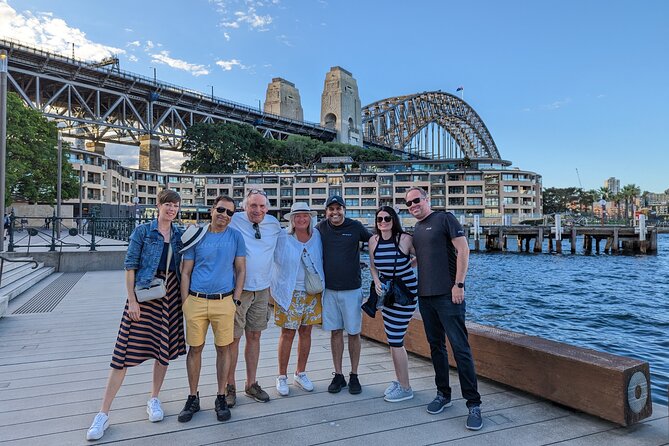
Sydney makes more sense when you walk it in layers. This small-group tour starts at Customs House, moves through colonial landmarks and city streets, then ends at The Squire’s Landing with a beer, an Aussie snack, and views toward the Opera House and Harbour Bridge. You get the city’s main story without spending a full day on your feet.
I like the four-kilometre route, which links major sights with less obvious corners such as Nurses Walk and Jack Mundey Place. I also like the final brewery stop, since a drink and harbour view give the tour a relaxed finish and leave you with time to ask for food and sightseeing tips. The main drawback is sound: busy streets and city events can make it hard to hear a guide, especially without a headset.
In This Review
- Key points at a glance
- Why this route works for a first look at Sydney
- Customs House and the first layers of Sydney
- The Mint, the Rum Hospital, and colonial power
- Hyde Park Barracks and the limits of the visit
- The Royal Botanic Garden and Governor Phillip Fountain
- The QVB, St. Mary’s, and Sydney’s grand public face
- Martin Place, the GPO, and the Anzac story
- The Rocks, Nurses Walk, and the route back to the harbour
- Opera House and Harbour Bridge views at the finish
- What the small group changes
- Price, pace, and practical value
- Who should book this Sydney walk
- Should you book the Ultimate Sydney Walking Tour?
- FAQ
- How long is the Ultimate Sydney Walking Tour?
- How far do you walk?
- Where does the tour start?
- Where does the tour finish?
- Is the beer included?
- Is food included?
- Do you enter the Opera House or walk on the Harbour Bridge?
- What happens if the weather is poor?
Key points at a glance
- Customs House opening: Begin with a scale model of Sydney and an introduction to Aboriginal place names and the route ahead.
- A layered city story: Hear about First Nations people, British settlement, convicts, migrants, the rum trade, and modern Sydney.
- Major sights in one walk: Pass the Mint, Hyde Park Barracks, St. Mary’s Cathedral, the QVB, Martin Place, The Rocks, and Circular Quay.
- Small group limit: A maximum of 12 people makes it easier to stay close to the guide and fit into narrow lanes.
- Harbour-side finish: Enjoy one small craft beer, soft drink, or juice, plus a classic Aussie biscuit at The Squire’s Landing.
- Best early in your visit: The route gives you useful bearings and practical ideas for where to eat, drink, and explore next.
Why this route works for a first look at Sydney
The tour covers about four kilometres over roughly three and a half hours. That is enough distance to connect Sydney’s historic core, central business district, parks, shopping arcades, and old harbour quarter, but it is not a forced march.
The route has a clear shape. You begin near Circular Quay, walk inland through the city, then return toward the harbour and The Rocks. Along the way, the guide explains how Sydney grew from an Aboriginal place into a British penal settlement, then into a migrant city and modern commercial centre.
That context is the real value here. You are not simply ticking off the Opera House, the QVB, or St. Mary’s Cathedral. You are learning why the city developed around certain streets, institutions, and harbour spaces.
I would book this near the start of a Sydney stay. The route gives you a useful mental map, and the guide’s suggestions about places to eat, drink, and explore can shape the rest of your visit. The tour is also a good fit if you have only a short time in the city and want more substance than a quick photo stop.
A few more Sydney trips to weigh up
- Sydney Opera House Official Guided Walking Tour
★ 4.5 · 3,770 reviews - From Sydney: Blue Mountains Tour with Waterfall Walk & Lunch
★ 4.8 · 2,400 reviews - Sydney The Rocks Guided Walking Tour
★ 5.0 · 1,546 reviews
Customs House and the first layers of Sydney
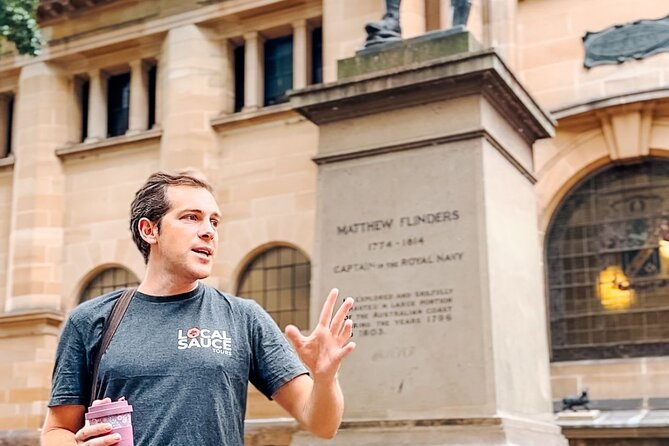
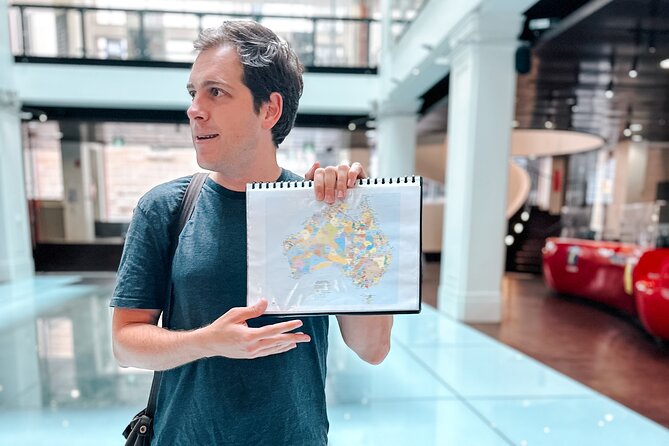
The meeting point is at 31 Alfred Street, beside Customs House. The tour begins with a scale model showing Sydney and the walking route, which helps you understand the geography before setting off.
This is also where the guide introduces Aboriginal place names and begins discussing the people who lived here before British settlement. That opening matters. Sydney’s story is not only one of convicts, governors, and grand buildings. The tour puts the impact of colonisation into the wider story of the city.
From Customs House, the guide sets the tone with a mix of history, present-day life, and practical orientation. Guides including Michael, Steve, Jake, Matt, Daniel, and Justin have been praised for using humour and answering questions, but the exact guide depends on the date of your booking.
The scale of the group helps here. With no more than 12 people, you should be able to stay near the guide and ask questions without competing with a large crowd. A smaller group can also move through narrow spaces more easily.
The Mint, the Rum Hospital, and colonial power
The walk continues past the former Rum Hospital, a group of buildings now associated with NSW Parliament, Sydney Hospital, and the Mint. This section shows how early Sydney’s institutions were tied to trade, government, medicine, and the alcohol economy.
The Mint is seen from outside, so this is not a museum visit. You are there for the story and the setting rather than an interior collection. That keeps the pace moving, though you should not book this tour expecting entry to historic buildings.
The guide uses the buildings to explain how British Sydney took shape. The city’s early structures were not isolated monuments. They were working parts of a settlement dealing with scarce supplies, political control, convict labour, and a growing population.
This is one of the tour’s strengths: the historical details are attached to real streets and buildings. You can see the place while learning what happened there, which makes the information easier to remember than a list of dates.
Hyde Park Barracks and the limits of the visit
At Hyde Park Barracks, you stop outside for about five minutes. The guide explains the building’s construction and its infamous architect, but you do not go inside.
That short stop tells you something useful about the format. This is a city walk with historical commentary, not a sequence of museum admissions. You will see many landmarks, but most are viewed from the street or nearby public spaces.
If Hyde Park Barracks is high on your list, plan a separate visit. The same applies to the Mint, St. Mary’s Cathedral, and the Opera House. The walking tour gives you an introduction and helps you decide which places deserve more of your own time later.
Same coast, a completely different day out:
- Sydney: Opera House Guided Tour with Entrance Ticket
★ 4.8 · 8,312 reviews - All Inclusive Blue Mountain,Scenic World,Lunch,Koalas,ferry
★ 5.0 · 7,832 reviews - From Sydney: Blue Mountains Full-Day Trip
★ 4.5 · 4,471 reviews - Blue Mountains Small-Group Tour from Sydney with Scenic World,Sydney Zoo & Ferry
★ 5.0 · 3,709 reviews
The Royal Botanic Garden and Governor Phillip Fountain
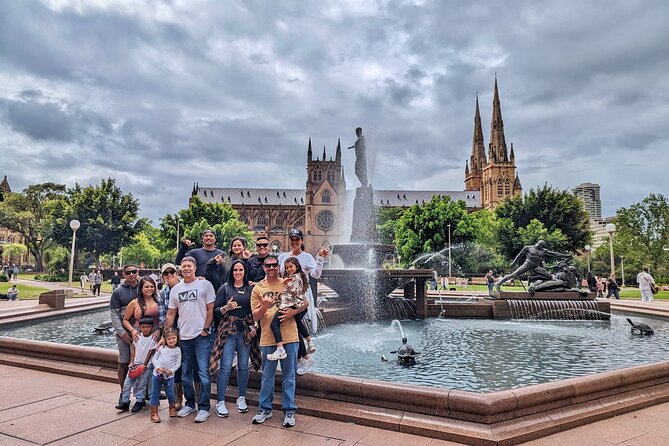
The group briefly enters the Royal Botanic Garden. You see the location of the former Garden Palace and Governor Phillip Fountain, with about ten minutes in this section.
The garden provides a welcome change from city streets. It also gives the guide room to connect Sydney’s public spaces with its colonial government and changing civic identity. You are not taking a long garden walk, so keep your expectations focused on a short visit and a historical explanation.
This part can feel especially useful on a sunny day, when the open space offers a break from the hard surfaces of the central business district. The tour still has a schedule, though, so you will not have time to explore the gardens at your own pace.
The QVB, St. Mary’s, and Sydney’s grand public face
The Queen Victoria Building is another brief interior stop. The group enters mainly to see the building and allow anyone to use the bathrooms.
The QVB is a strong example of Sydney’s grand civic and commercial architecture. Even a short look inside gives you a sense of the building’s scale and decorative character. Treat it as an orientation stop rather than a full architectural tour.
The route then reaches Hyde Park, where you get a view of St. Mary’s Cathedral from around 50 metres away. You do not enter the cathedral or walk directly up to it.
That distance is worth noting if you want close architectural photographs or an interior visit. Still, the park gives you a good setting for seeing the cathedral within the wider city. The guide can explain how this part of Sydney brings together religious, civic, and commercial landmarks within a compact area.
Martin Place, the GPO, and the Anzac story
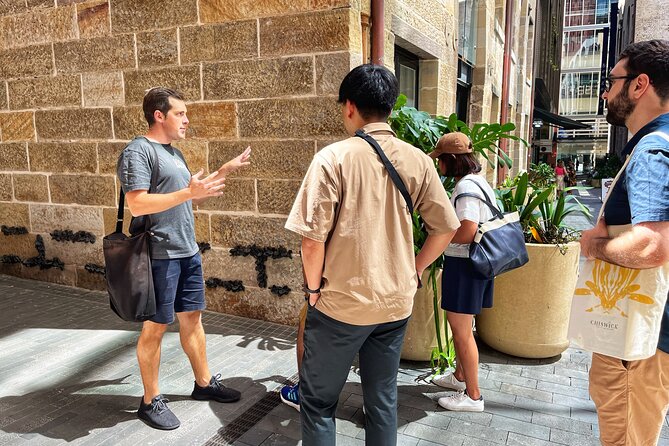
At Martin Place and Pitt Street, the group stops to look at the General Post Office and hear about its controversial construction and design. This is a quick five-minute stop, but it adds a useful point to the walk: Sydney’s public buildings were often shaped by arguments over style, money, power, and civic pride.
Martin Place also brings in the Anzac Cenotaph and Australia’s involvement in World War I. The tour does not treat Sydney’s past as only a colonial origin story. It connects the city to national memory and Australia’s place in the wider world.
The historical range is one reason the tour works well for first-time visitors. You hear about Aboriginal Sydney, British settlement, convicts, migrants, the rum trade, public institutions, wartime memory, and modern city life in one continuous walk.
The guide’s style matters in this part. Previous guides such as Steve, Jake, Michael, Matt, and Daniel have been praised for combining facts with humour, and for explaining difficult subjects in a clear way. You should still expect a story-led walk rather than a formal lecture.
The Rocks, Nurses Walk, and the route back to the harbour
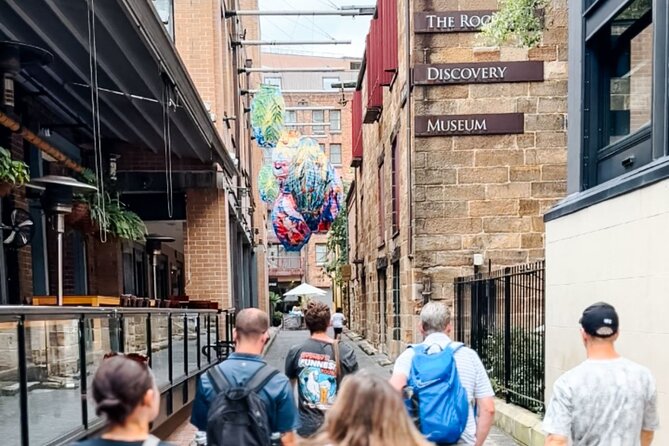
Near the end, the tour enters The Rocks and passes through Nurses Walk, Jack Mundey Place, and lower George Street. This is where the route feels less like a standard city-centre overview.
The Rocks offers older lanes, harbour history, and a closer connection to Sydney’s early settlement. Nurses Walk and the smaller passages are also where a group of 12 or fewer has a practical advantage. A large group can feel awkward in narrow spaces, while a small one can stop without blocking the whole route.
The tour covers only part of The Rocks. You will get an introduction, not every street or museum. If you enjoy the area, you can return later and explore it more slowly.
This section also helps connect the city you have just crossed with the harbour in front of you. The route began near Customs House, moved through the CBD and parks, and now returns to the waterfront with more historical context.
Opera House and Harbour Bridge views at the finish
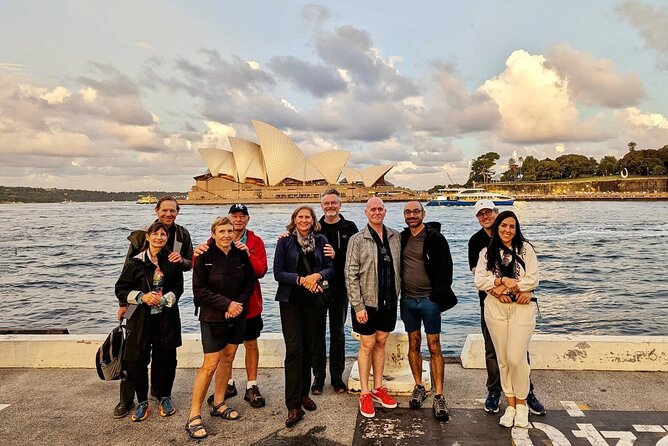
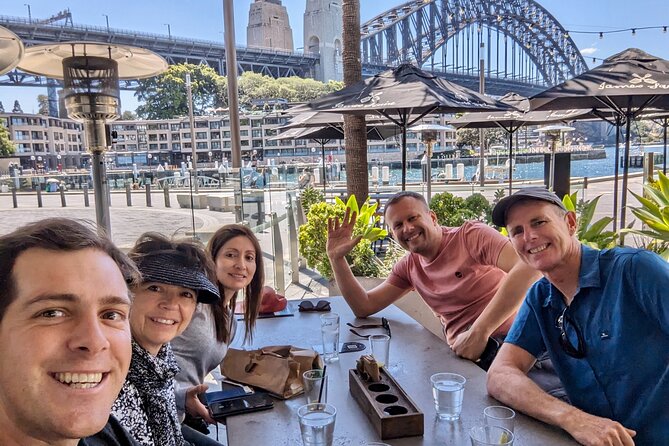
The walking portion finishes at The Squire’s Landing, at the northern end of the Overseas Passenger Terminal. From here, you get views of the Sydney Opera House and Sydney Harbour Bridge.
You do not enter the Opera House, and you do not walk on the bridge as part of the tour. The bridge is only a short walk from the endpoint if you want to continue exploring on your own.
The finish is well chosen. Instead of ending on an ordinary city street, the tour closes with two of Sydney’s best-known sights in view. You can take photographs, settle in for a drink, and ask the guide about what to do next.
Included in the price is one small glass of craft beer for adults aged 18 and above, or a soft drink or juice. You also receive one classic Aussie snack or biscuit. The drink is a modest inclusion, not a full meal, so plan to eat separately if you are hungry after three and a half hours of walking.
What the small group changes
The maximum group size is 12 people. That is smaller than many tours marketed as small-group experiences, and it affects the way the walk feels.
You are more likely to hear the guide, ask a question, and remain part of the conversation. The group can also move through lanes and crowded areas with less delay. Solo visitors may find the format particularly comfortable because it is easier to stay involved than in a large crowd.
There is one important limit. The tour does not use a headset system, and city noise can sometimes make the guide difficult to hear. Busy New Year preparations were one reported example, and another issue arose when a guide spoke toward a landmark instead of facing the group.
You can help by staying close, especially near traffic and crowded streets. The operator’s suggested spacing is about three to four metres from the guide, but sound conditions will vary. If hearing every word is important to you, ask early if the group can gather tightly at each stop.
Price, pace, and practical value
At $57.38 per person, the tour is priced above a basic free walking tour, but the comparison is not quite like for like. You are paying for a three-and-a-half-hour route, a small group capped at 12, a guide’s historical storytelling, a map with recommendations, group photos, and a beer or soft drink with a snack.
The value is strongest if you want an efficient introduction to Sydney. You cover major areas in one outing, then finish with a harbour view rather than paying separately for a sightseeing cruise or a guided visit at every landmark.
The value is weaker if you prefer to spend long periods inside museums, churches, or historic buildings. Most stops are outside, and several are only five or ten minutes long. You are buying explanation, context, and orientation more than admission tickets.
Wear comfortable shoes and dress in layers suited to the weather. The tour requires you to walk about four kilometres over three hours, and it can be uncomfortable if you are not used to extended city walking. The activity is not recommended for children under 12 because of the walking and three hours of stories.
Service animals are allowed, and the start and finish are near public transport. The tour requires good weather. If poor weather cancels it, you can choose another date or receive a full refund. Standard free cancellation is available up to 24 hours before the start time, while cancellations or changes inside that window are not accepted.
Who should book this Sydney walk
I would choose this tour if you want history with a human guide, rather than a recorded commentary or a quick photo circuit. It suits first-time visitors, solo visitors, couples, and anyone who wants practical advice for the rest of a Sydney stay.
It is also a good choice if you care about the relationship between Aboriginal Sydney and British settlement. The tour includes that subject from the opening stop and carries it through the wider story of the city.
You may want another option if you have limited mobility, dislike walking for several hours, need guaranteed amplified sound, or want to enter the Opera House, Hyde Park Barracks, the Mint, or St. Mary’s Cathedral. Those sites are seen from outside or nearby, not toured inside.
Should you book the Ultimate Sydney Walking Tour?
Book it if you want a well-paced first look at Sydney, a small group, and a guide who can connect landmarks to the city’s past and present. The strongest parts are the route design, the range of subjects, the personal feel of guides such as Michael, Steve, Jake, Matt, and Daniel, and the final drink with Opera House and Harbour Bridge views.
Before booking, be honest about the four-kilometre walk and the possibility of street noise. If you are comfortable with both, this is a practical way to get your bearings, learn why Sydney looks the way it does, and leave with useful ideas for the rest of your visit.
FAQ
How long is the Ultimate Sydney Walking Tour?
The tour lasts approximately three hours and 30 minutes.
How far do you walk?
You walk about four kilometres, or roughly 2.5 miles, over about three hours.
Where does the tour start?
The meeting point is at 31 Alfred Street, Sydney NSW 2000, Australia, near Customs House.
Where does the tour finish?
The tour finishes at The Squire’s Landing, at the northern end of the Overseas Passenger Terminal at Circular Quay in The Rocks.
Is the beer included?
Yes. Adults aged 18 and above receive one small glass of craft beer. You can choose a soft drink or juice instead.
Is food included?
One classic Aussie snack or biscuit is included. The tour does not include a full meal.
Do you enter the Opera House or walk on the Harbour Bridge?
No. You see both landmarks from the finishing area, but the tour does not enter the Opera House or take you onto the Harbour Bridge.
What happens if the weather is poor?
The experience requires good weather. If it is canceled because of poor weather, you will be offered another date or a full refund.
Just added around Sydney
- Taronga Zoo Sydney Wild Australia Experience★ 4.8 · 64 reviews
- Sydney: Spirits of the Rock and Dark Past Walking Tour★ 4.0 · 144 reviews
- Sydney: Whale Watching Cruise and Taronga Zoo Package★ 4.2 · 37 reviews
- Sydney Harbour: Tall Ship Lunch Cruise★ 4.8 · 69 reviews
- Sydney: Whale Watching Adventure Cruise – Whales Guaranteed!★ 4.4 · 76 reviews
- Sydney Whale Watching Cruise with Breakfast or Lunch★ 4.4 · 340 reviews
- Sydney: The Gentleman Magician’s Magical Soirée with Tickets★ 4.0 · 25 reviews
- Sydney: Ultimate City Pass for 4 Attractions with Skywalk★ 4.4 · 60 reviews
Walking Tours, compared.
Sydney Opera House Official Guided Walking Tour
Read our review →
Blue Mountains Tour with Waterfall Walk & Lunch
Read our review →
Ultimate Melbourne Walking Tour: History, Laneways & Culture
Read our review →

Great Ocean Road Tour Plus Koalas, Forest Walk and Morning Tea
Read our review →
Blue Mountains Small Group Tour with Waterfall Walk & Fresh Lunch
Read our review →
Maria Island Cruise and Guided Walk Day Tour with Lunch and Drinks
Read our review →
Sydney Cricket Ground (SCG) and Museum Walking Tour
Read our review →Browse the lists this tour appears in